

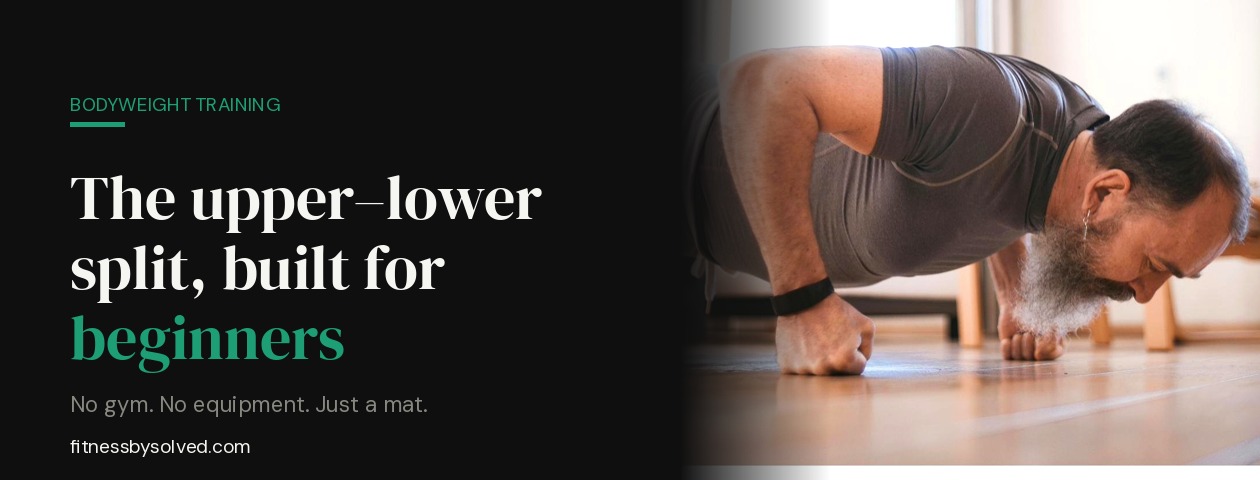
If you've been looking into home workouts, you've probably come across the phrase “upper lower split” — and wondered whether it's something you actually need, or just gym jargon.
Here's the short version: an upper lower split is one of the simplest, most effective ways to structure strength training. You train your upper body one day, your lower body the next, and alternate. It's used by beginners and experienced lifters alike, and the best part is you don't need a gym or a single piece of equipment to do it.
Why the upper lower split works so well
Most people who start training at home fall into one of two traps. They either do the same full-body routine every day and burn out, or they train randomly with no structure and never progress.
The upper lower split solves both. By separating upper and lower body days, each muscle group gets a proper rest before you train it again — which is when it actually gets stronger. And because the structure is fixed, you always know what you're doing that day. No decisions, no guesswork.
For a beginner, that consistency matters far more than intensity.
How to structure your week
The simplest version is four sessions a week — two upper, two lower — with rest days built in:
- Monday — Upper body
- Tuesday — Lower body
- Wednesday — Rest
- Thursday — Upper body
- Friday — Lower body
- Weekend — Rest
If four days feels like too much to start, drop it to two — one upper, one lower — and build up. The structure stays the same; you're just adjusting the volume to fit your life.
What each session looks like
You don't need machines or weights. Bodyweight movements cover everything a beginner needs.
Upper body focuses on pushing and pulling: push-ups, pike push-ups for the shoulders, tricep dips off a chair, and core work like shoulder taps and planks. As you get stronger, you add reps or slow the movements down.
Lower body covers squats, reverse lunges, glute bridges, wall sits and calf raises. These hit your quads, glutes, hamstrings and calves — the muscles that carry you through daily life.
Each session takes around 20 minutes. That's short enough to actually stick to, which is the whole point.
The one thing beginners get wrong
Progression. Doing the same ten push-ups every week won't get you stronger forever. The magic is in gradually doing a little more — one extra rep, one more set, a slightly harder variation. That steady progress is what turns a random routine into real results.
If you'd rather not build all this yourself, we've put the entire system into a done-for-you plan. Our 20-minute bodyweight training programme lays out all four sessions — two upper, two lower — with a built-in 4-week progression plan and a tear-out reference sheet. No equipment, just a mat.
Start this week
You don't need to overhaul your life to get stronger. Pick two days this week — one upper, one lower — and do a 20-minute session each. Next week, add a third. That's how an upper lower split becomes a habit, and how a habit becomes a stronger, more capable body.
The best home workout is the one you'll actually do. Keep it simple, keep it consistent, and let the structure do the work.
Questions or feedback? Get in touch.
Comments ()