

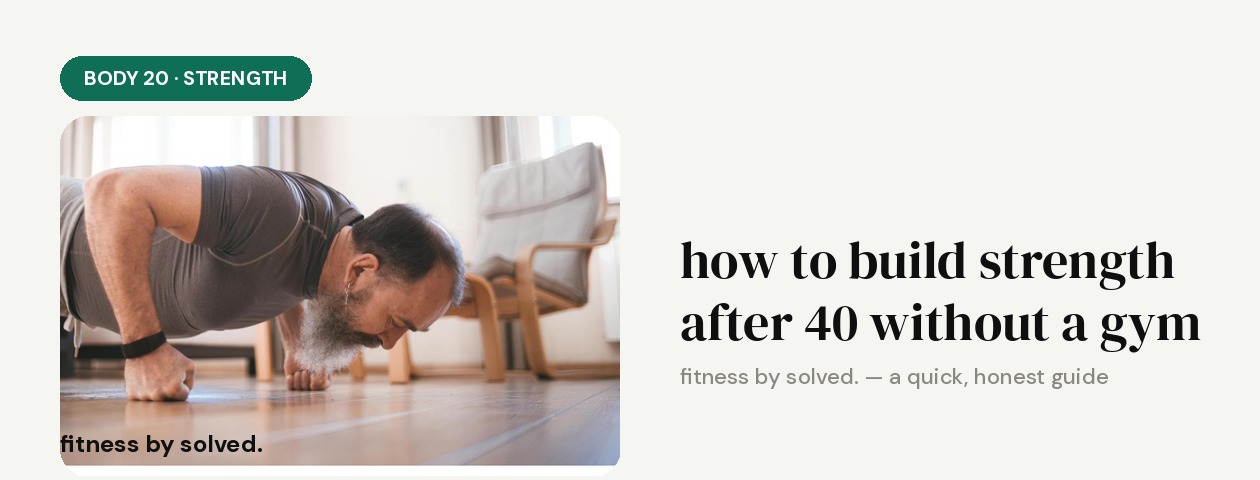
After 40, strength stops being optional. Muscle mass declines by roughly 3-8% per decade once you pass 30, and that rate speeds up with each year after 40. It's not just about how you look — it's grip strength, balance, bone density, and how easily you get up off the floor at 65. Left unaddressed, that decline compounds quietly for years before it shows up as a stiff back, a tweaked shoulder, or stairs that feel harder than they used to.
The good news: none of this requires a gym membership, a rack of dumbbells, or an hour you don't have. Strength training after 40 is less about finding more time and more about using the time you have with intention.
Why bodyweight training still works after 40
Muscle doesn't know the difference between a barbell and your own bodyweight — it only knows tension, and how long that tension is applied. A well-structured bodyweight session creates plenty of both. Push-ups, split squats, planks, and rows using a sturdy table edge can all be loaded progressively, just like a weighted exercise. The muscle-building stimulus is the same; the equipment is not.
What changes after 40 isn't your ability to build strength — it's your ability to recover from doing too much too fast. That's a programming problem, not a limitation on what your body can do.
The three things that actually matter
Most people overcomplicate strength training. After 40, three principles do almost all of the work:
- Progressive overload, adapted. You don't need heavier weights to progress — you can slow the tempo, add a pause at the hardest point of a movement, or move from an easier variation (knee push-up) to a harder one (full push-up, then decline push-up).
- Consistency over intensity. Two or three focused sessions a week, done for months, will out-perform one brutal session followed by a week of soreness and avoidance. Recovery capacity is the thing that actually shifts with age — respect it and progress keeps coming.
- Movement quality first. Full range of motion, controlled tempo, and proper joint alignment protect the tendons and joints that take longer to heal than they used to. Rushing a rep for the sake of a rep is where injuries after 40 usually start.
A simple weekly structure
A realistic starting point is two upper-body-and-core focused sessions and one lower-body focused session each week, with at least one rest day between sessions that hit the same muscle groups. Twenty minutes is enough if the exercises are chosen well and the rest periods are short but not rushed. This is exactly the structure behind a 20-minute bodyweight strength routine, built specifically for people training at home without equipment.
Mistakes that slow people down after 40
The most common one is skipping a proper warm-up — five minutes of joint mobility and light movement makes a bigger difference at 45 than it did at 25. The second is chasing soreness as a marker of progress; soreness fades as your body adapts, and that's a sign of improvement, not stalled results. The third is abandoning a routine after a missed week. Two sessions a week, restarted without guilt, beats a perfect plan you gave up on in March.
Where to start today
You don't need to overhaul your week to start building strength again. Pick two days, commit twenty minutes, and focus on quality over quantity for the first month. If you want the structure already built for you — sets, reps, and progressions included — a 20-minute bodyweight strength routine is a straightforward way to start without guessing.
Strength after 40 isn't about chasing what you could do at 25. It's about building something durable enough to rely on for the next 40 years.
Questions about this post or want a training plan tailored to you? Get in touch.
Comments ()