

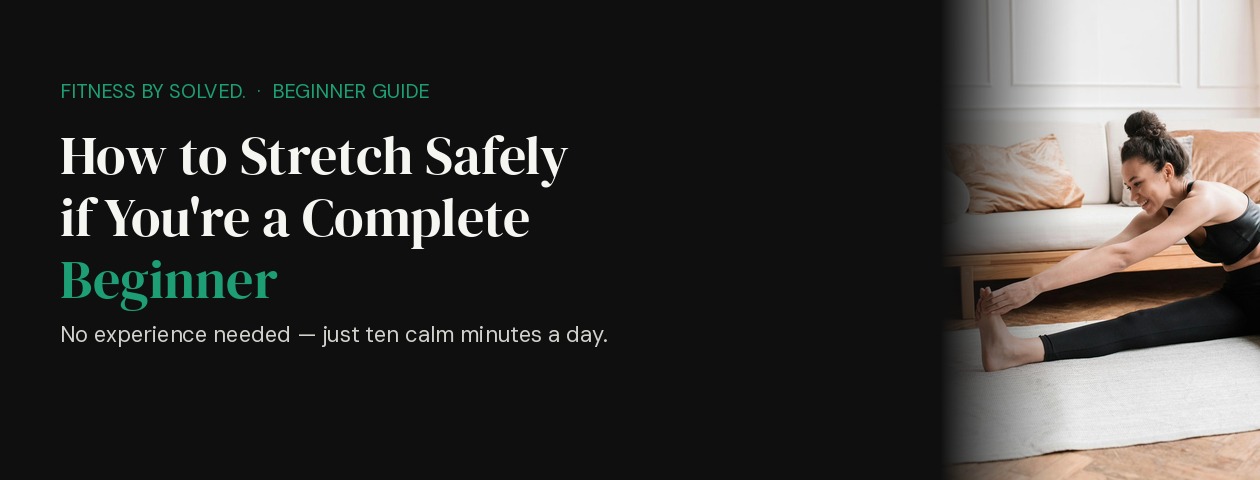
If you've never stretched properly before, it's easy to feel like you're doing it wrong — pushing too hard, holding too long, or picking exercises that are more advanced than they look. The good news is that safe stretching is simple once you know the basic rules. You don't need flexibility to start. You just need the right approach.
Warm up before you stretch, not after
A common beginner mistake is stretching cold muscles first thing in the morning or straight after sitting all day. Muscles stretch more safely — and more effectively — once they have a little blood flow moving through them. A minute or two of gentle movement, like marching on the spot or slow arm circles, is enough to prepare your body before you hold anything.
Ease in — never force a stretch
Safe stretching should feel like mild tension, not pain. If you feel sharp discomfort, pinching, or shaking, you've gone too far. Back off until the sensation is gentle, then hold there. Over days and weeks, your range of motion increases on its own — you never need to force it by pushing harder.
Hold each stretch for 20 to 45 seconds
Beginners often hold stretches for a few seconds and move on, which isn't long enough for the muscle to actually release. Aim for 20 to 45 seconds per stretch, breathing slowly throughout. Holding your breath tends to make the body tense up, which works against you.
Start with a short, structured routine
Rather than guessing which stretches to do, it helps to follow a short, structured sequence built for beginners — one that moves through the areas that get tightest from sitting and everyday movement, in a safe order, without needing any equipment. This 10-minute daily mobility routine was built for exactly this — it opens in a new tab so you can keep reading.
A few beginner mistakes to avoid
Bouncing into a stretch (known as ballistic stretching) increases injury risk for beginners — ease in slowly instead. Comparing your flexibility to anyone else's is unhelpful too; everybody's starting point is different, and consistency matters far more than how far you can reach in week one. Finally, skipping stretches that feel awkward rather than uncomfortable is a mistake — awkward usually just means unfamiliar, and it fades with practice.
The bottom line
Safe stretching for beginners comes down to a few simple habits: warm up first, ease in gently, hold for long enough, and follow a structured sequence rather than improvising. None of it requires experience — just a few calm minutes and a routine that removes the guesswork.
Questions? Get in touch — we'd love to hear from you.
Comments ()