

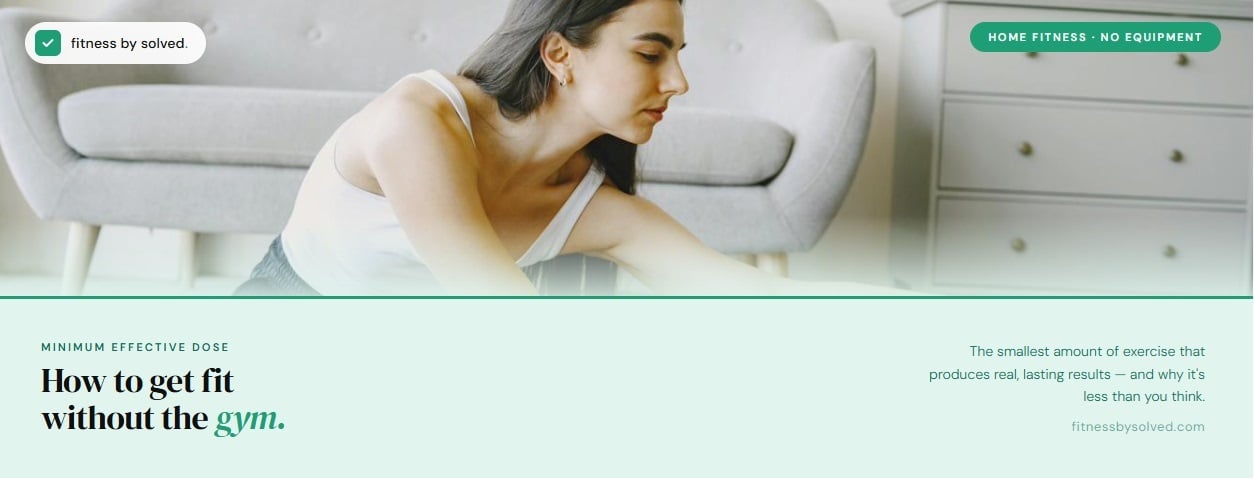
The fitness industry has a vested interest in making exercise feel complicated. The more equipment, the more classes, the more coaching you think you need — the more money changes hands. But the science of how the body actually adapts to exercise tells a very different story.
The minimum effective dose is the smallest amount of stimulus required to produce a measurable, lasting result. In fitness, that dose is far smaller than most people believe — and it does not require a gym, a personal trainer, or more than 20 minutes of your day.
What the Research Actually Shows
Studies consistently show that the relationship between exercise volume and results is not linear. Beyond a certain threshold, adding more time and more sessions produces diminishing returns. Below that threshold, even small amounts of the right exercise produce significant, measurable improvements in strength, mobility, cardiovascular fitness, and body composition.
For sedentary adults — which describes most busy professionals — the threshold is low. Three to four short bodyweight sessions per week, combined with daily mobility work, is enough to produce real, visible change within four to six weeks. Not gym-adjacent change. Actual change.
The key word is consistency. A minimum dose applied consistently outperforms a maximum dose applied sporadically, every single time.
Why the Gym Model Fails Most People
The gym model has two fundamental problems for busy adults.
The first is the time commitment. Getting to a gym, training, showering, and returning home takes a minimum of 90 minutes. For someone with a full-time job, a family, and a commute, finding 90 minutes five times a week is not a scheduling challenge — it is structurally impossible.
The second is the friction barrier. On days when motivation is low — which is most days, for most people — the effort required just to get to the gym is enough to stop the habit forming. The decision point comes before any exercise has happened. And the decision is almost always no.
Home-based bodyweight training removes both problems. The commute is zero. The barrier to starting is a mat on your bedroom floor. The decision point is much simpler: will you lie on the floor for 20 minutes, or not?
What the Minimum Effective Dose Looks Like in Practice
For strength and body composition, the minimum effective dose looks like this:
- 4 sessions per week, 20 minutes each
- Upper body twice, lower body twice
- 5 exercises per session, 3 sets each
- Progressive overload through harder variations as you adapt
For mobility and flexibility — particularly important for desk workers — the minimum effective dose is even smaller:
- 10 minutes per day
- 10 targeted stretches covering the key areas affected by sitting
- Done consistently for 30 days
Together, these two protocols take 90 minutes across a full week. Less than one gym session. Done at home, with no equipment, at whatever time of day suits your schedule.
The Compound Effect of Small Consistent Actions
The body does not care that the sessions are short. It responds to the signal — the mechanical stress placed on the muscles and connective tissue — not to the duration of the session. What it responds to most powerfully is regularity.
A muscle exposed to the right stimulus three times a week adapts. A muscle exposed to the same stimulus once a fortnight does not. This is why the minimum effective dose, applied consistently, produces results that feel disproportionate to the effort involved.
Week one feels like nothing is happening. Week two feels slightly easier. Week four, you notice your posture has changed. Week six, your clothes fit differently and the afternoon energy dip has mostly gone.
None of this required a gym.
How to Start
The simplest way to apply the minimum effective dose is to separate mobility and strength into two distinct daily practices — one that takes 10 minutes every morning, one that takes 20 minutes four times a week.
The mobility practice keeps the body moving well, addresses the damage done by desk work, and can be done in pyjamas before coffee. The strength practice builds the functional muscle that makes daily life easier, protects the joints, and improves how you look and feel without requiring any equipment at all.
If you want a structured starting point, The Body 20 is a 20-minute bodyweight training programme with four sessions a week — upper body, lower body, no gym, no equipment.
A structured 20-minute bodyweight training system for busy adults. 4 sessions per week — upper body twice, lower body twice. 5 exercises per session, a 4-week progression plan, and a tear-out reference sheet. No gym. No equipment. Just a mat. Instant download at fitnessbysolved.com.
Pair it with a daily 10-minute mobility routine and you have a complete home fitness system that fits around real life — not the other way around.
─────────────────────────────────────────────────────────
Published by solved. · fitnessbysolved.com · hello@fitnessbysolved.com
Comments ()