

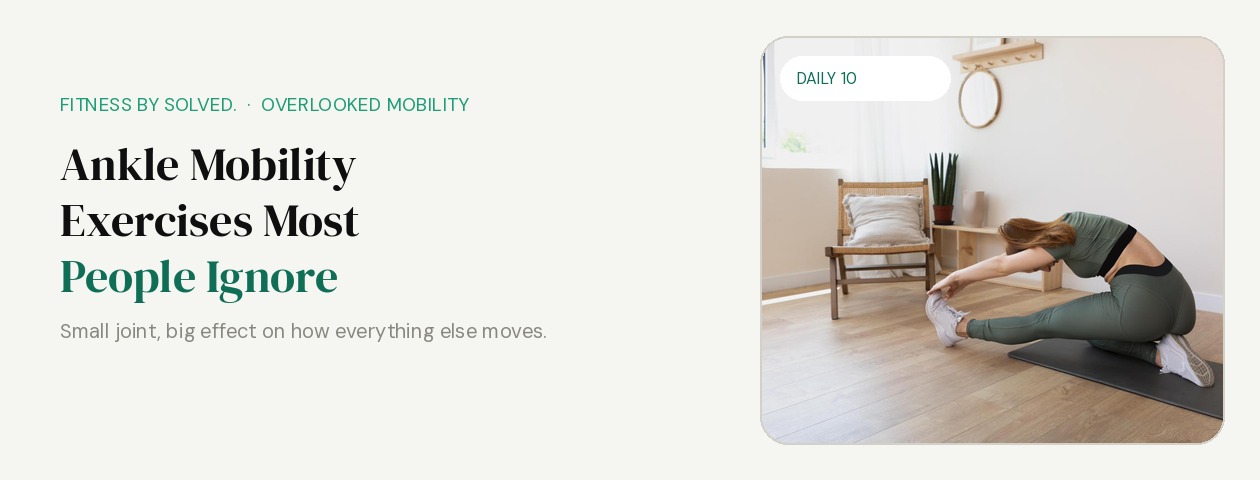
Ankles rarely get the attention hips, shoulders, or backs do — but they're the foundation almost every lower-body movement is built on. A restricted ankle changes how your knee tracks in a squat, how stable you feel walking on uneven ground, and how far you can comfortably lunge. Most people never notice the restriction; they just adapt around it without realizing that's what's happening.
Why ankle mobility gets overlooked
Ankles are a small, single joint doing a lot of quiet work, and restriction there rarely produces obvious pain the way a tight hip or back might. Instead, it shows up indirectly — as knees that cave inward during a squat, or balance that feels less steady than it used to. Because the ankle itself doesn't complain, it's easy to spend years working around a restriction rather than addressing it.
Ankle circles
Sit or lie down and lift one foot off the ground. Slowly rotate your ankle through its full range of motion — ten circles clockwise, then ten counter-clockwise. Simple as it is, this is one of the most direct ways to take the joint through the movement it rarely gets during a normal day of standing and walking in one direction.
Wall ankle stretch (knee-to-wall test)
Stand facing a wall, place your toes a few inches back from it, and try to touch your knee to the wall without your heel lifting off the ground. If you can't quite reach it, that's useful information about your current range — practice holding a gentle stretch at your current limit for 20 to 30 seconds per side, and the distance tends to close gradually with repetition.
Seated toe and heel raises
Sitting with your feet flat on the floor, alternate lifting your toes while your heels stay down, then lifting your heels while your toes stay down. Ten to fifteen reps of each. This works the muscles that control ankle movement, not just the joint's passive range — mobility and the strength to control it tend to matter equally.
Downward-dog ankle pumps
From a downward-dog position (hands and feet on the floor, hips lifted), gently pedal your feet, bending one knee while pressing the opposite heel toward the floor, then switching. This combines a calf and ankle stretch with movement rather than a static hold, which many people find loosens tight ankles more effectively. If you'd like ankle work built into a complete daily sequence, this 10-minute daily mobility routine covers it alongside the rest of the body — it opens in a new tab so you can keep reading.
The bottom line
Ankle mobility rarely announces itself the way tightness elsewhere does, which is exactly why it's worth checking on directly rather than waiting for a signal. A few minutes of targeted movement a few times a week is often enough to noticeably improve how stable and capable your lower body feels overall.
Questions? Get in touch — we'd love to hear from you.
Comments ()